
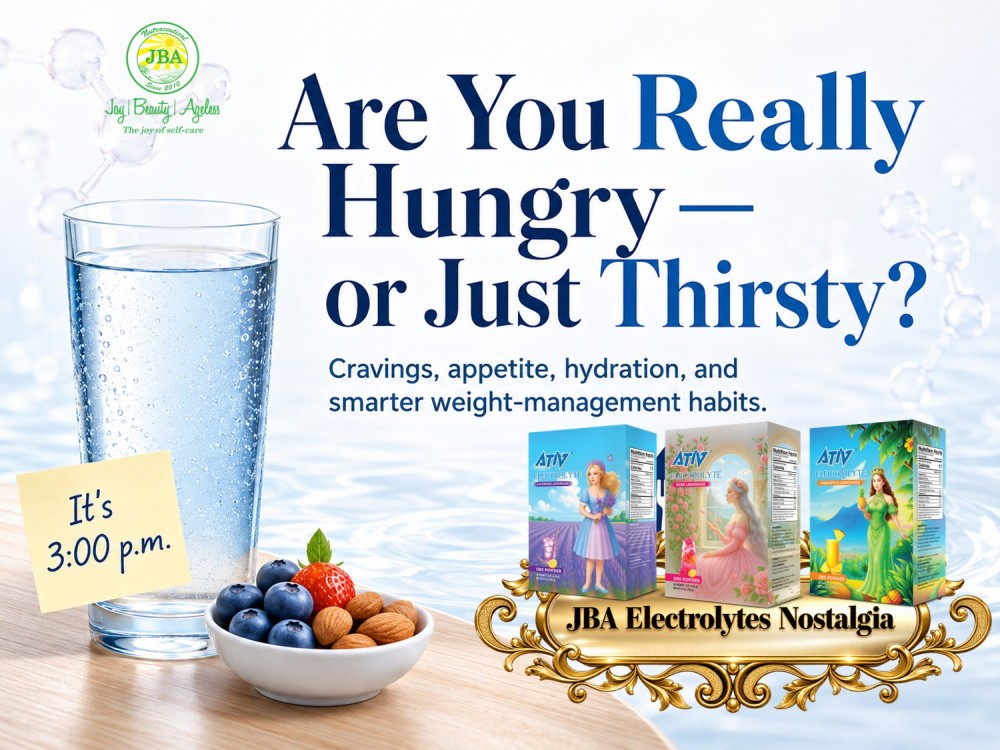
Are You Really Hungry — or Just Thirsty?
Are You Really Hungry — or Just Thirsty?
It’s 3:00 p.m. You’re tired, slightly unfocused, and suddenly craving something sweet. A cookie sounds good. So does a sweet coffee. Maybe a handful of chips. But before you decide you’re hungry, there’s another question worth asking: when was the last time you actually drank water?
Hunger and thirst are not the same signal.
But in everyday life, they can sometimes feel surprisingly similar.
Low energy.
Poor concentration.
A dry mouth.
A vague desire to “have something.”
And because food is often more appealing than plain water, it’s easy to interpret that feeling as hunger.
That doesn’t mean every craving is dehydration.
Far from it.
But if you’re trying to manage your weight, learning to distinguish true hunger, habit, thirst and cravings can make a meaningful difference.
First, Thirst Does Not Literally Become Hunger
There’s a popular claim online that says:
“Your body confuses thirst with hunger.”
That’s too simplistic.
Your brain has separate systems involved in regulating hunger and thirst.
But human behavior is more complicated than a single biological switch.
We often eat because we’re tired.
Because we’re stressed.
Because food is nearby.
Because it’s 3 p.m.
Because we associate television with snacks.
Or simply because something tastes good.
Thirst can become one more signal mixed into that environment.
So rather than saying thirst “causes” hunger, think of it this way:
Sometimes a craving arrives at the same time your body also needs fluid.
And when that happens, hydrating first can help you decide what you actually need.
1. The 3 P.M. Craving May Not Be About Calories
Think about a typical workday.
Breakfast at 7:30.
Coffee at 9.
Another coffee after lunch.
Meetings.
Emails.
Phone calls.
Then suddenly it’s mid-afternoon.
You’ve had caffeine and food, but perhaps very little water.
Now you’re tired.
Your concentration is slipping.
And your brain wants something rewarding.
Sugar provides a quick, familiar reward.
That doesn’t necessarily mean your body urgently needs a pastry.
You may simply need a short break, some fluid, movement — or all three.
This is why a useful weight-management habit is:
Hydrate first. Then reassess.
Drink some water.
Give yourself a few minutes.
If you are still genuinely hungry, eat.
But if the craving fades, you may have avoided calories you never actually needed.
2. Cravings Are Different From True Hunger
True hunger tends to build gradually.
You may feel an empty stomach.
Your energy may fall.
And several different foods sound appealing.
A craving is often more specific.
You don’t want “food.”
You want:
Chocolate.
Ice cream.
Chips.
A sweet coffee.
A particular dessert.
That doesn’t make cravings bad.
But it does make them useful clues.
If you’re craving something specific shortly after eating a full meal, pause before assuming you need more calories.
Ask yourself:
Am I hungry?
Am I thirsty?
Am I bored?
Am I stressed?
Am I tired?
Or do I simply want the taste?
Sometimes the answer really is:
“I want the chocolate.”
That’s okay.
The goal is awareness — not perfection.
3. Drinking Water Before Eating May Help Some People
There is research suggesting that drinking water before meals can help reduce calorie intake in certain groups.
The effect is not magical, and it may not be the same for everyone.
But the idea makes physiological sense.
Water adds volume in the stomach without adding calories.
That additional volume may contribute to fullness.
For someone trying to lose weight, even small reductions in calorie intake can matter when repeated consistently.
This does not mean you should force yourself to drink enormous amounts before every meal.
A better approach is simple:
Arrive at meals adequately hydrated.
When your body is not playing catch-up on fluids, you may find it easier to pay attention to actual hunger and fullness.
4. Liquid Calories Are Often the Bigger Problem
Sometimes the issue isn’t the snack.
It’s what you drink with it.
A sweetened coffee.
A milk tea.
A soda.
A juice.
An energy drink.
A smoothie loaded with sweeteners.
Liquid calories can be easy to consume because they often don’t create the same feeling of fullness as a solid meal.
So when you are thirsty, choosing a calorie-containing drink can create an interesting problem:
You solve the thirst.
But you may also consume hundreds of calories.
Then you eat the meal anyway.
For weight management, one of the simplest strategies remains one of the most effective:
Let hydration be hydration.
Use water as your default.
Then choose calories intentionally when you actually want food.
5. But Plain Water Isn’t Always the Whole Story
There are moments when your body loses more than water.
Long exercise sessions.
Hot weather.
Heavy sweating.
Outdoor work.
Travel.
Illness involving significant fluid loss.
In those situations, electrolytes may also need attention.
Sweat contains sodium and other electrolytes.
So after substantial sweating, the goal is not simply to drink as much water as possible.
The goal is to restore fluid balance appropriately.
This is where an electrolyte drink can make sense.
But there is an important weight-management detail:
Read the label.
Some sports drinks contain significant sugar and calories.
That may be useful during prolonged endurance exercise.
But if your goal is simply hydration during an ordinary day, those additional calories may not be necessary.
Choose the hydration strategy that matches your activity.
6. The Evening Snack Is Often More Habit Than Hunger
Here’s another familiar situation.
Dinner is finished.
You’re satisfied.
Two hours later, you sit down to watch television.
Suddenly you want something.
Fruit.
Nuts.
Ice cream.
Cookies.
Maybe a glass of wine.
Is your body truly hungry?
Sometimes.
But often, the brain has simply learned:
TV = snack.
That association can become remarkably strong.
One small experiment can reveal a lot.
Before the evening snack, drink some water or a low-calorie beverage and wait a short while.
Then ask:
“Would I eat something simple right now?”
An egg?
Some plain yogurt?
A piece of chicken?
If the answer is no — but cookies still sound wonderful — you may be experiencing a craving rather than physical hunger.
Again, this doesn’t mean you can’t eat the cookie.
It simply helps you make the choice consciously.
7. Sleep Can Make Everything Harder
Hydration is only one part of appetite regulation.
Poor sleep can change hunger signals, increase appetite and make highly palatable foods more appealing.
That’s why some days are simply harder.
You slept badly.
You wake up tired.
You drink more coffee.
You reach for sugar.
You move less.
Then you snack again at night.
It’s easy to think:
“I have no willpower.”
But sometimes several physiological factors are working together.
This is why sustainable weight management should never be reduced to a single rule.
Hydration.
Sleep.
Movement.
Nutrition.
Stress.
Routine.
All of them influence the decisions you make around food.
8. The Best Question Is Not “Am I Allowed to Eat This?”
Diet culture often teaches people to ask:
Can I eat this?
A more useful question may be:
“What does my body actually need right now?”
Food?
Water?
Electrolytes?
Rest?
Movement?
Or simply something enjoyable?
That question changes the relationship with food.
You stop treating every craving as an emergency.
And you stop treating every snack as a failure.
Instead, you become better at recognizing patterns.
That is exactly the kind of skill that makes weight management sustainable.
Try the 10-Minute Hydration Check
The next time an unexpected craving hits, try this:
Drink a glass of water.
If you’ve been exercising heavily or sweating significantly, consider whether electrolyte replacement is appropriate.
Then give yourself about ten minutes.
Do something else.
Walk around.
Answer an email.
Step outside.
Then check again.
Are you still hungry?
If yes, eat something.
Preferably something that gives you useful nutrition — protein, fiber, healthy fat or a combination.
If the craving disappeared?
You learned something valuable about your body.
Where JBA Electrolytes Nostalgia Fits
We don’t believe an electrolyte product should be marketed as an appetite suppressant.
And it isn’t a weight-loss drug.
Its role is simpler.
Hydration support when electrolyte replacement makes sense.
For people who exercise.
People who walk outdoors.
People who sweat heavily.
People living in hot climates.
Or anyone trying to build a more thoughtful hydration routine.
Used correctly, hydration becomes one small part of a much larger weight-management strategy.
Not a miracle.
Not a shortcut.
A foundation.
The Bigger Lesson
Successful weight management is rarely about fighting your body.
It is about understanding it.
Learning when you are hungry.
Learning when you are thirsty.
Recognizing cravings.
Noticing patterns.
And making hundreds of small decisions a little more intentionally.
That’s where real progress usually happens.
Not in one dramatic day.
But in what you repeat.
A Simple Daily Rule
When you feel unexpectedly hungry between meals:
Hydrate.
Pause.
Reassess.
Then decide.
If you’re hungry, eat.
If you’re thirsty, hydrate.
If you’re craving something purely because you enjoy it, you can still choose it — just know why you’re choosing it.
That awareness may be one of the most underrated tools in long-term weight management.
Coming Next
Why Does Losing Weight Sometimes Make You Feel More Tired?
Calories, hydration, electrolytes, muscle and the mistake of cutting too much too quickly.You start a diet.
You eat less.
The scale begins moving.
But after a week or two, something else happens.
You’re tired.
Your workouts feel harder.
You’re colder.
You’re hungry all the time.
And suddenly the diet that looked so successful becomes difficult to maintain.
In Part 5, we’ll look at why aggressive calorie restriction can backfire, how hydration and electrolytes fit into the picture, and why protecting muscle may be one of the most important parts of successful weight loss.